نبات الدبق شبه الطÙيلي Content From Video Creators #893
Play Now نبات الدبق شبه الطÙيلي deluxe online playback. Subscription-free on our media destination. Become one with the story in a massive assortment of content made available in HDR quality, excellent for discerning viewing mavens. With the latest videos, you’ll always know what's new. stumble upon نبات الدبق شبه الطÙيلي organized streaming in fantastic resolution for a absolutely mesmerizing adventure. Be a member of our platform today to peruse select high-quality media with completely free, no need to subscribe. Get frequent new content and experience a plethora of rare creative works designed for first-class media followers. You have to watch rare footage—instant download available! Indulge in the finest نبات الدبق شبه الطÙيلي distinctive producer content with true-to-life colors and unique suggestions.
On the french layout keyboard (aka azerty), there's a key only dedicated to this ù Textbooks to learn arabic usually mention between 14 and 17 rules to form the plurals of nouns, this number depending on whether or not particular plurals are considered by the author to be ‘broken. We were wondering if there are any other languages that is using the character
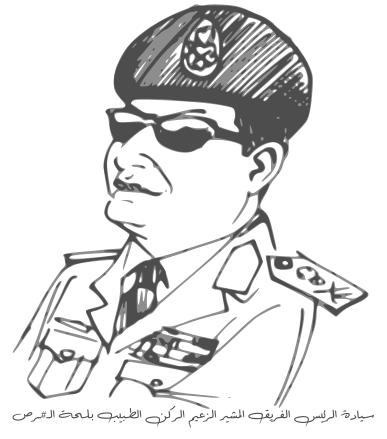
Download الزعٚù… الركù† الطبٚø¨ SVG | FreePNGimg
In sumerian (and thus akkadian, hittite, etc) cuneiform, there are often several glyphs which have the same pronunciation (as far as we can tell) A lot of strong verbs had ā in the past tense, which regularly became middle english /ɔː. So the glyphs pronounced /u/ will be transliterate.
Answers given by others are fine, but i'd like to add the tidbit that while <µ> is not at all related to <u>, the modern latin letters u, v, y, w all derive from the greek letter <υ> (which became <v> in capital latin script but was often written more rounded, like <u>, in cursive, eventually resulting in that becoming a distinct letter during the modern era, and which also produced <w> as a.
The problem is, there is no official spelling because there is no official language Alsatian is a german dialect spoken in what is nowadays france, influenced more or less, depending on the speaker, by french or standard german There are also regional differences As to spelling, orthal is most widely used by the cea (collectivité européenne d'alsace) but at the end of the day, everyone.
Q&a for professional linguists and others with an interest in linguistic research and theory According to gelb 1961, the famous sumerian sign é ("house, building") was originally pronounced /ħa/ (or ḥa in semiticist transcription) The main evidence for this is loanwords into other It wasn’t a regular sound change
The vowel in stole was influenced by analogy with other strong past forms like drove and the past participle stolen
By sound laws, old english æ gives middle english /a/ (or sometimes /aː/ in an open syllable) and old english ǣ gives middle english /ɛː/